
4. How networks shape buildings
Expanding on Chris's network ontology, and connecting to the work of the others

1 Update and forecast
So far, I’ve looked at two areas in which Alexander’s insights and intuitions are well-supported by current philosophy and research
A relational ontology, in which the world is seen as a network of relations, rather than an arrangement of objects—such relational thinking is at the heart of contemporary philosophy and social science.
The central and positive role of feeling in human decision-making, as currently being investigated by neuroscience.
In addition, I see two other areas which have strong connections with contemporary culture and scholarship:
The central role of language in shaping not just communication, but also thought and behaviour
The 15 properties, as a summary of a certain kind of order that appears in many human artefacts
So far, I see at least two problems:
Chris’s insistence on having one and only one true criterion for “good design”. Of all the terms he’s used, the clearest is this one: “objective value”. I want to describe how value can be objective, and common, while still not universal, and how this is the norm in biological life.
His insistence on seeing architecture—the making of buildings—as a craft, produced by a single person in charge, whose prime function is to “pour feeling” into the object being made
In this note, I want to look more closely at Chris’s insight into how networks—of interaction and of knowledge—shape the forms of buildings and cities.
2 The Sepik post footing
Below is a diagram of a post detail. This comes from work that I began with my colleagues at the Community Based Building Program in Papua New Guinea in the late 1970s, and the detail is still in use—with some evolution—today.
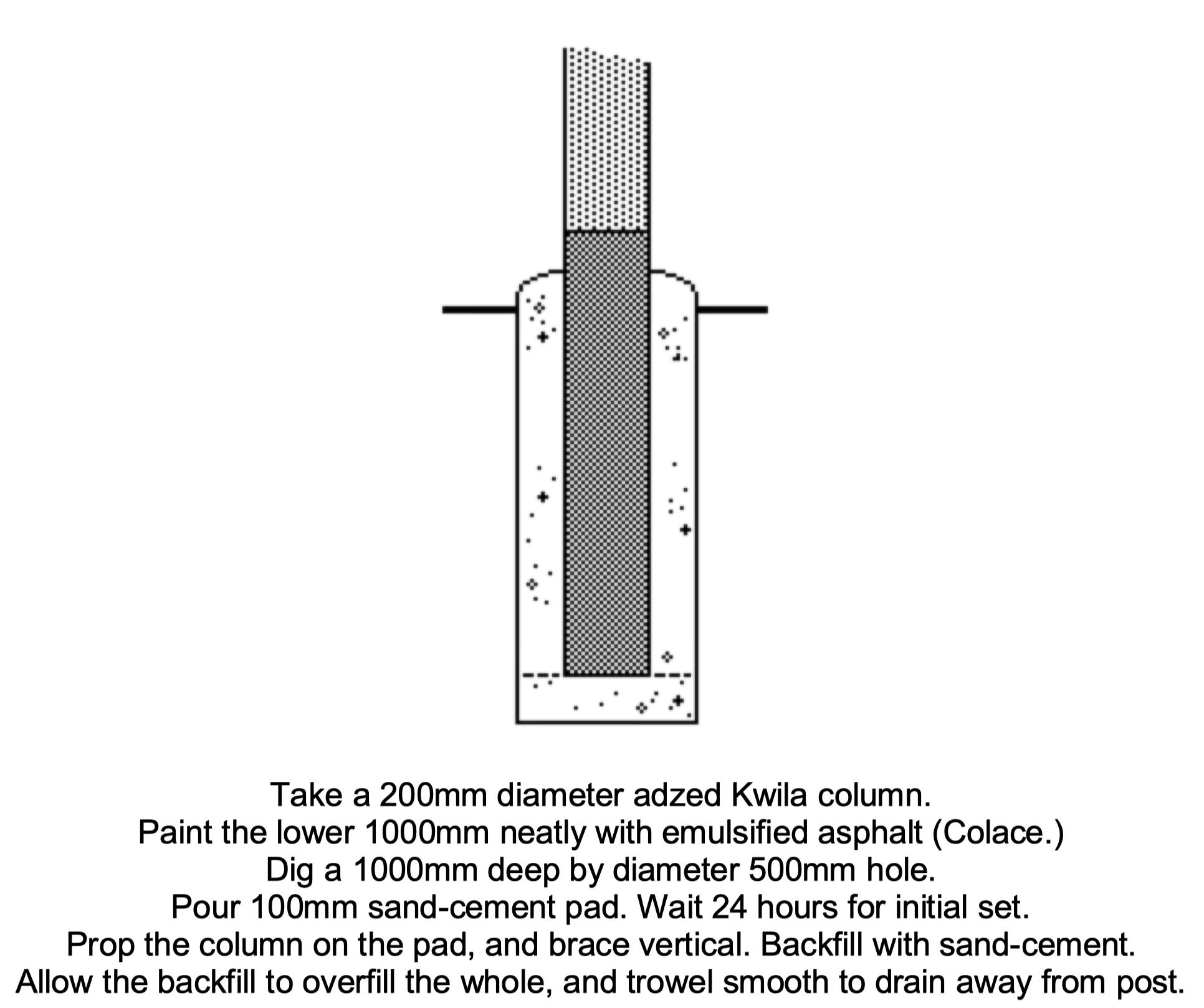
The Sepik is where we did our first building projects, in the Gavien Resettlement Scheme.
Aside: This particular drawing was done in McPaint—which dates it technologically!
This detail was developed from thinking and observations made by Ken Costigan and myself, based on some ideas taken from a prior school construction project, and from observations of Sepik traditional architecture and construction processes.
These led to the formulation of a pattern called “Cantilever Posts”, which stated that the structural system of the building should be based on these posts cantilevered out of the ground—no shear walls, no cross-bracing—which had the following benefits:
Was familiar to the local people
Allowed, in the Sepik tropical environment, easy construction of areas with few walls—such as large verandas or open-sided classrooms—or buildings with no walls at all, such as the traditional “haus win” (a Melanesian Tok Pisin transliteration of “house wind”).
Also allowed the roof to be constructed first, and the rest of the construction process (floors, walls, etc.) to be carried out sheltered from the harsh sun and frequent tropical downpours.
The specific design logic of the form is:
For the posts, we chose Kwila, the naturally durable wood used by the Sepik people for building posts. It was readily available, and posts could be locally produced.
Kwila gets its durability from natural tannins, but these tannins can be leached out by the movement of water, and so if exposed to rain and groundwater, the tannins can leach out, and the wood becomes susceptible to decay. Therefore, we add a layer of protection to the base of the post, where it is most exposed to the rain and to the bacteria in the ground.
To make it structurally more stable, and to further protect the base with send-cement, we encase the embed part of the post in sand-cement: aggregate not being locally available.
In addition to questions of durability, structure, and local acceptability and tradition, the whole design is also influenced by considerations of local availability of materials, simplicity of construction, constructability, appearance, and cost.
3 From forces to perspectives
In “From a Set of Forces to A Form”, Alexander talks about replacing the fuzzy term “need” with forces, a force being a drive to move in a certain direction. He cautions that: “A force is an invention. It is an invented motive power which summarizes some recurrent and inexorable tendency which we observe in nature.”
Alexander also cautions, however, that:
“Forces generate form. In the case of certain simple natural systems, this is literally true. In the case of complex, man-made systems, it is a metaphor.”
The problem with this metaphor on the complexity of “forces” at work, and the examples that Alexander gives are generally not helpful, when turn to complex human systems of psychological and social behaviour.
For instance, is there a force driving cost down? To what a limit? How does the “cost” force interact with a proposed “appearance” force? Our relationship to money is subtle, complex, and variegated, and not readily distilled to a single tendency.
A more natural approach is to consider these “needs” or “forces” as representing a certain perspective. When an architect looks at the design of a footing, he brings to bear certain perspectives:
contribution to structural stability of the overall building
durability in the Sepik tropical environment and biome
appearance to ourselves and our stakeholders
constructability using mostly the local skills base
alignment with local practice, knowledge and traditions
And each of these perspectives brings to bear a certain kind of knowledge—structural engineering, wood science, soil science, intuitions about appearance, sequence of construction, local availability of materials, local costs, target budget, and so forth.
In shifting from “forces” to “perspectives” we allow the subtle and complex machinery of the human beings to bring evaluation, interpretation, and know-how into the picture.
In the Gavien project, we also applied our own ideological considerations: maintain the knowledge inherent in the local traditions, create local employment in materials supply and construction, make the end-result competitive with imported buildings, in both cost and sensibility. These are some of what made our buildings distinctive from the increasingly preferred foreign models of architecture.
This is a more naturalist description of how actual architectural and building work happens. In any building project there are certain viewpoints that need to be considered. In a large urban project, the range of perspectives starts to break up into different professional disciplines, which you can see on project notice boards. In others, they are combined into one person. Where I was working, in the Gavien Resettlement Scheme, some of these perspectives were limited to what I had absorbed in my education at Berkeley.
In design meetings, the conflicts between these different perspectives are nutted out through conversations. When designing alone, one often proceeds by shifting between these different perspectives, trying to iron out conflicts and problems, or achieve greater strength in a particular perspective.
This had been nicely described by the philosopher of biology Humberto Maturana:
Everything that is said is said by an observer to another observer who may be him or herself.
This is what design discussions are about. Shall we do this? Too expensive. Looks wonky. Vulnerable to rain. Not strong structurally. There’s a negotiation that happens between all these perspectives. And that negotiation shapes the design.
What are these perspectives? Each comes a from a community of practice, which maintains a body of knowledge. And that knowledge flows from the community into its practitioners. With knowledge also comes power, in which some perspectives dominate others: structural stability will over-rule aesthetics.
How are those perspectives mediated in the design? At least three common ways:
Satisficing: which is when the designer or team decide it’s “good enough”, because time is always pressing to move onto the next.
This term was coined by the Nobel laureate social science Herbert Simon for the fact that we make decisions without ever enough time enough information to make them optimal. Instead, in practice, we opt for “good enough” on any criteria.
Phronesis: is the experienced judgement of people who have been practicing a long time and have an embodied sense of what will and will not work. It is an old term which dates to Aristotle’s theory of knowledge.
An engineer I know told me of looking over the steel frame going up on a site next door and thought it looked wrong. I-beams often have stiffeners or flanges welded onto the compression side of the beam, to prevent that side from buckling. He looked at the frame and immediately thought: those reinforcement are on the wrong side of the beam.
Power: not all perspectives command equal authority, and the financier might say, “I won’t pay for this”, the engineer “I won’t sign off it”, the city authority “I won’t permit it”, and the end-user “I don’t like it”.
Notice that this is not arbitrary power. It is vested in each case in certain claims to knowledge and exemplifies the way in which power works in modern society. This is most famously analysed by Foucault: as power-knowledge, which is diffuse, and circulates through society—not the personal authority of any one person. The engineer is not free to do what they want; they too are bound by the strictures of their role.
4 Designs as nodes in a net
Now if we pull back and look for how the different “forces” (or let’s now say perspectives) work, this is what we see:
There are certain people involved in shaping the design, not all of them “designers”
These people bring to the design certain perspectives, which represent certain bodies of knowledge
Those bodies of knowledge can be individual (e.g. the client) or collective, with hundreds of years of experience practiced by millions of practitioners (e.g. structural engineering).
The design of anything, then, is the confluence of different human perspectives on a certain situation. The designer is not the sole, god-like author of the design, but in fact is a node in a network of knowledge—both tacit and explicit—that extends out into diverse communities, each of which has a history of how that knowledge developed.
I argue that this is a more factually accurate view of how designs come into being: they are nodes—points within vast networks in which humans play a central role and often form clusters, but which also include non-human elements such as exemplary buildings (both positive and negative), textbooks, scholarly work, manuals, regulations, standards, conventions, and traditions.
Another way to put this is that designs are more cultural products, than they are individual ones.
The above analysis of the post footing design, conducted about 25 years ago, arose from the realization that patterns alone could not fully explain the actual process at work. In reality, each design serves as a node within a complex network of human and non-human actants (as Latour describes them), through which influence flows. While knowledge is the primary medium of this influence, other factors—such as money, power, desire, and authority—also play important roles in shaping the outcome.
I’m sitting here, looking at the design of one of the guitars I have hanging on the wall.

I can see the influences that have flowed into it:
The tradition of stringed instruments
Wood science
Acoustic science
Questions of weight and cost
Experience embodied in previous guitar designs
The influence of leading guitarists
Somewhere in the design of that guitar is the luthier who designed and built this particular guitar. He only created a particular inflection on a form which has been shaped by thousands in the network of guitar-making through the ages.
None of this way of thinking would be possible for me without being primed by:
Chris’s intuition about forces shaping form, which is takes a different tack to design than the more commonplace idea of design as a work of creative genius
His work on a relational ontology, including the networks described in Notes on the Synthesis of Form, “A City Is Not A Tree”, and The Timeless Way of Building.
At the same time, I could have built on that understanding with the work of:
Michel Foucault on power-knowledge, and power as a network phenomenon
Bruno Latour on Actor-Network Theory
Jean Lave and Etienne Wenger on communities of practice
Clifford Geertz on culture.
I think Chris’s work deserves more attention than he’s received so far. His approach, his attempt to rebuild architecture from the ground up has led to an isolated reach of rivers and oceans of discourse. Correcting that means connecting him more strongly what to Richard Rorty called “the conversation of humankind”.
Chris’s particular contribution, I think, is his practice of always “operationalising” ideas—which for him meant translating them into practical action—and his skill in expressing novel ideas in plain English, for a wide audience.
And this is one reason why I’m bothering to sift through Chris’s work. Because in operating alone, he could travel far and fast, but he isolated himself. Power, influence, meaning, impact—these are network phenomena. By connecting his thought to the major networks and flows of thought now in the 20th and 21st centuries, his ideas can assume a more (in my view) rightful position. But this is as participant, contributor and interlocuter, not as solo artist.
Finally, it was Chris who set me up to understand quite readily these larger networks and flows, and thus Chris is also useful bridge to anyone who doesn’t want to spend years understanding highly abstract academic tomes. There’s something to be learned there too.